

The Machine Behind School Choice: How the CNP Network Reengineered Constitutional Law and Public Education
A transformed Free Exercise doctrine now compels states to subsidize religious education. A coordinated political infrastructure ensures that outcome is embedded in state policy.

I. The Presumption of Neutrality
The Supreme Court has created a constitutional environment in which voucher and ESA programs are treated as neutral mechanisms for parental choice even though they channel public money into institutions that are exempt from the constitutional, educational, and accountability obligations that define the public education mission. The Court’s modern religion jurisprudence has collapsed the Establishment Clause while expanding institutional Free Exercise rights. The result is a framework in which states are required to fund religious instruction through programs that appear neutral on their face but leave states with almost no authority to maintain the secular character of publicly funded education.
This doctrinal shift did not arise in isolation. Internal Reagan Administration documents from the Office of Public Liaison, including memoranda circulated by Morton Blackwell, reveal a coordinated political strategy to weaken the Establishment Clause, redefine school vouchers as a matter of religious freedom, and normalize public funding of religious education. These documents describe a deliberate effort to restructure constitutional interpretation so that religious institutions could claim discrimination when denied public funds. The strategy anticipated the Court’s later reasoning in cases such as Zelman, Espinoza, and Carson, where the Court held that states may not exclude religious schools from public funding programs unless they can point to an actual Establishment Clause violation. As scholars have observed, this approach eliminates the constitutional space once known as the play in the joints and leaves states with almost no discretion when religion is involved.
The Court now assumes that voucher programs are neutral because they route public funds through parental choice, even though the schools receiving those funds are not required to follow the standards that define public education. This assumption has no empirical foundation. Research on Christian education demonstrates that many fundamentalist schools rely on prepackaged curricula such as Accelerated Christian Education. A study of ACE graduates found significantly lower ACT scores in most subjects. These findings indicate that the academic preparation provided by such schools does not match the expectations of higher education and does not align with the skills identified by researchers as essential for college success.
Families often enter voucher programs not because they seek religious formation but because the voucher system leaves them with no secular alternatives. As Black (2022) explains, the Court now treats efforts to avoid funding religious indoctrination as “odious” discrimination, co‑opting the language of race and sex discrimination to justify requiring states to include religious schools whenever they subsidize private education. This doctrinal framing obscures the reality that many families who use vouchers do not share the school’s faith but have no other viable option.
The modern funding structure fulfills the Reagan era objective of elevating institutional religious rights above the state’s obligation to provide an adequate and equitable education. The doctrinal shift has produced a system in which states must subsidize institutions that are not required to meet the standards that define public education. The result is a constitutional vulnerability that undermines the public education mission and reshapes the legal landscape in ways explored in the sections that follow.
II. The Supreme Court Has Collapsed the Establishment Clause While Expanding Institutional Free Exercise Rights
The Supreme Court’s recent Free Exercise decisions have transformed the constitutional structure governing public funding and religious education. In Carson v. Makin, the Court held that Maine’s attempt to ensure that students in rural districts received a publicly funded secular education violated the Free Exercise Clause. Black explains that the Court has “chosen education as a primary stomping ground for rewriting Free Exercise Clause doctrine” (Black, 2022, p. 558). The decision marks a shift from a framework in which states could choose whether to fund religious education to one in which states must include religious schools whenever they subsidize private schooling.
Maine’s program was designed to satisfy the state’s constitutional duty to provide public education in districts too sparsely populated to operate a public high school. Districts could contract with nearby schools or pay tuition at a school selected by families, with the goal of providing “access to opportunities that are equivalent to the public education that students would otherwise receive in their district” (Black, 2022, p. 563). In 1981, the legislature barred tuition payments to sectarian schools to ensure that publicly funded instruction remained secular. Maine excluded only those schools that used public funds for “the religious purposes of inculcation and proselytization” (Black, 2022, p. 564).
The First Circuit upheld this approach as a permissible use-based restriction. It distinguished between discrimination based on religious affiliation and discrimination based on the religious use of public funds. The Supreme Court rejected that distinction and treated Maine’s nonsectarian requirement as status-based discrimination. The Court held that excluding religious schools from a generally available tuition benefit violated the Free Exercise Clause (Black, 2022, pp. 565–566). The Court then went further and declared that use-based restrictions are not “any less offensive to the Free Exercise Clause” than status-based exclusions (Black, 2022, p. 567). This eliminated the doctrinal line that had allowed states to prevent public funds from supporting religious instruction.
Black argues that the Court’s reasoning collapses the constitutional space known as the play in the joints. This space historically allowed states to avoid entanglement with religion while respecting free exercise. The Court now requires states to demonstrate an actual Establishment Clause violation before they may decline to fund religious activity. Black writes that the Clauses are now “joined at the hip,” leaving states “very little (if any) discretion when dealing with issues of religion” (Black, 2022, p. 562). The Court’s approach elevates institutional religious rights above the state’s interest in maintaining the secular character of publicly funded education.
The consequences for public education are significant. Black notes that public education is already burdened by “obvious and pressing inequities and inadequacies” (Black, 2022, p. 560). These include persistent racial achievement gaps, resegregation, and chronic underfunding. Public schools have also faced political attacks and resource losses since the Great Recession (Black, 2022, pp. 560–561). Against this backdrop, the Court’s decisions intensify pressure on public schools by requiring states to subsidize religious instruction while limiting their ability to regulate the use of public funds.
Black emphasizes that private-school tuition subsidies will not address the structural problems facing public education. He notes that these subsidies “originally grew out of racism” and that the private-school sector remains disproportionately white and resistant to diversity, equity, and inclusion, particularly for LGBTQ youth (Black, 2022, p. 561). By mandating religious access to voucher programs and restricting state authority to impose secular standards, the Court’s doctrine elevates religious interests over educational equity and adequacy.
The logic of Carson also invites challenges to public education itself. Black warns that the theory underlying the decision “extends all the way to public-school coffers,” raising claims that reserving public funds for public schools discriminates against religion (Black, 2022, p. 561). Although such claims lack grounding in historical practice or precedent, the Court’s recent decisions have emboldened litigants to pursue them. States retain the option to eliminate voucher programs, but political trends make that unlikely. Instead, states must attempt to craft religiously neutral criteria that indirectly exclude institutions unwilling to meet equity-oriented standards, a task Black describes as difficult in systems already committed to deregulated schooling (Black, 2022, p. 562).
The Court’s jurisprudence now requires states to fund religious schools while sharply limiting their ability to regulate the use of public funds. States may no longer rely on the Establishment Clause to justify excluding religious instruction from publicly funded programs. They may not impose use-based restrictions that prevent public money from supporting religious indoctrination. They may not require religious schools to provide an education equivalent to that required of public schools. The Court has created a constitutional structure in which institutional religious rights override the state’s responsibility to secure equitable and adequate education for all children.
III. The Reagan–Blackwell Documents Reveal a Coordinated Political Strategy That Engineered the Modern Free Exercise Revolution
The documentary record from the Reagan Presidential Library shows that the transformation of the Supreme Court’s religion jurisprudence was not an organic evolution of constitutional interpretation. It was the intended outcome of a coordinated political strategy operating inside the Executive Office and through a private network of organizations, most prominently the Council for National Policy. These documents reveal that the Reagan Administration and the CNP sought to redefine public funding of religious schools as a matter of constitutional right and to construct a political coalition capable of normalizing that shift until courts would treat exclusion of religious institutions from public programs as discrimination. The memos show that the administration was not responding to constitutional doctrine. It was attempting to create it.
This strategy was articulated publicly before it was implemented. The 1980 Republican Party platform declared that “federal education policy must be based on the primacy of parental rights and responsibility” and reaffirmed support for “a system of educational assistance based on tax credits” to compensate parents for private school tuition. This framing recast public funding of religious education as a matter of parental rights rather than a departure from the Establishment Clause, laying the political groundwork for the legal arguments that would later appear in Zelman, Espinoza, and Carson.
The internal documents fall into three categories that together reveal the architecture of the strategy: access and coordination, policy integration, and external mobilization.
Access
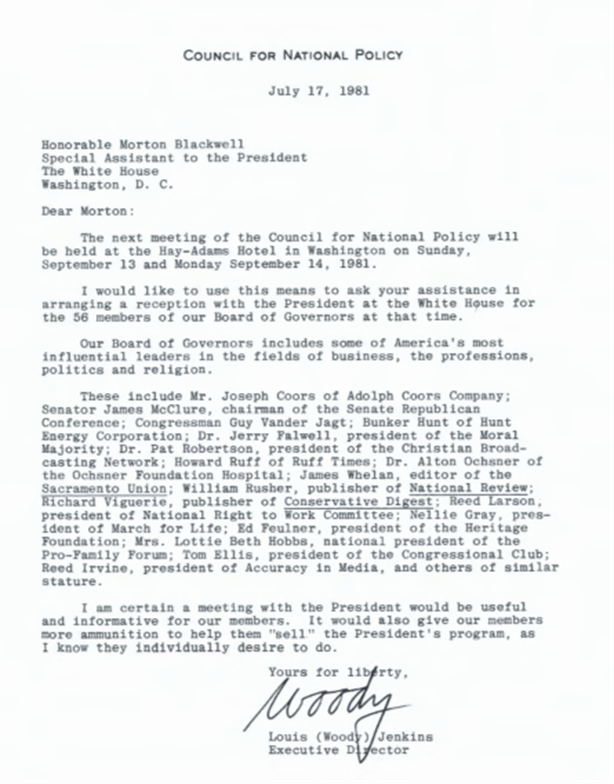
The first set of documents shows how the CNP secured direct access to the White House and positioned itself as the administration’s primary political partner. A 1981 letter from CNP Executive Director Louis “Woody” Jenkins to Morton Blackwell requested that Blackwell arrange a private White House reception for the CNP Board of Governors. Jenkins wrote that such access would give CNP leaders “ammunition” to “sell the President’s program” and described the CNP as “an umbrella organization for all major national conservative leaders and organizations.” Blackwell, who served simultaneously as Special Assistant to the President and as a CNP board member since May 1981, functioned as the conduit between the Executive Office and the private coordinating body that directed the Christian Right’s political infrastructure.
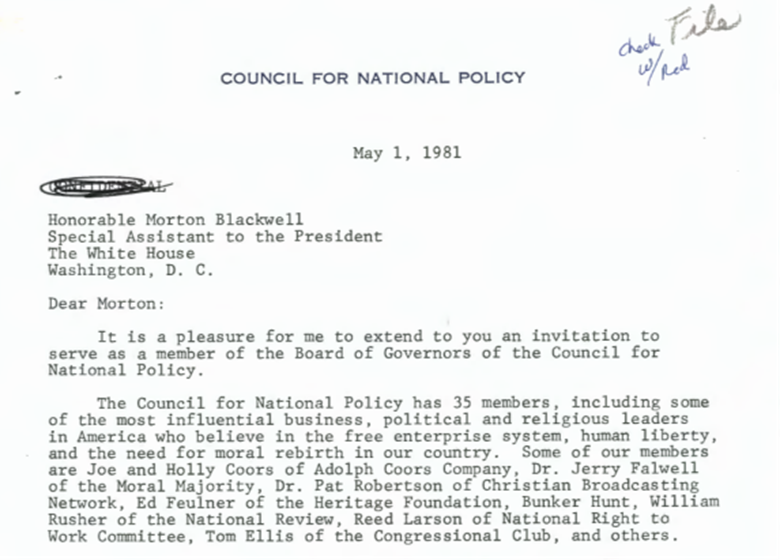
The CNP’s recruitment letter to Blackwell in August 1982 confirms that the organization was intentionally building a national leadership structure to advance a unified policy agenda. The criteria for new board members required influence in government, business, religion, or media and ideological commitment to free enterprise and “family values.” Because CNP members simultaneously led the Moral Majority, Christian Voice, the National Pro‑Life PAC, the Heritage Foundation, and the Committee for the Survival of a Free Congress, the recruitment process strengthened CNP’s position as the strategic center of a multi‑organizational political network.
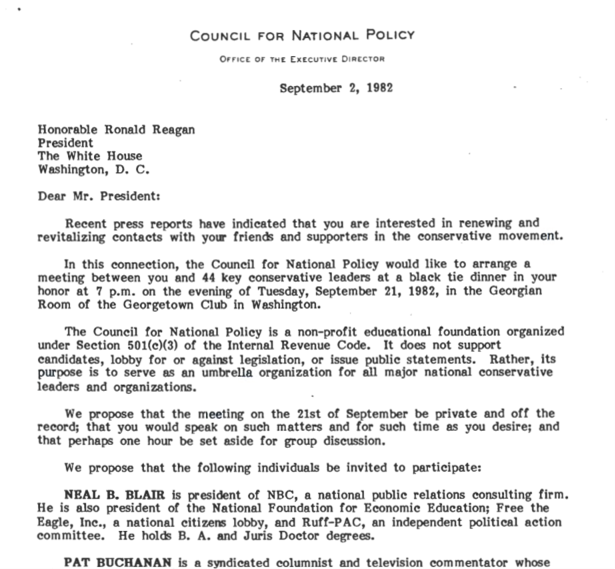
A September 2, 1982 letter to President Reagan demonstrates how the CNP used this structure to secure direct presidential access. The letter proposed a private, off‑the‑record meeting with forty‑four of the most influential conservative activists in the country, many of whom were credited with Reagan’s 1980 victory. The letter insisted that the CNP “does not support candidates, lobby for or against legislation, or issue public statements,” even as it requested a closed‑door policy session with the President. The proposed attendees included Jerry Falwell, Tim LaHaye, Paul Weyrich, Richard Viguerie, Phyllis Schlafly, Edwin Feulner, Nelson Bunker Hunt, Connie Marshner, Dick Dingman, and Kathleen Teague.
Teague’s presence is especially significant. She served as Executive Director of the American Legislative Exchange Council and simultaneously held leadership positions in the Free Congress Foundation and the Committee for a Free China. Her inclusion shows that ALEC’s state‑level legislative apparatus was already integrated into the CNP network in 1982. The 2020 leaked CNP roster confirms this continuity by listing Lisa B. Nelson, CEO of ALEC, as a CNP member. This establishes a direct line from the Reagan‑era coalition to the modern legislative drafting engine responsible for school‑choice expansion, voucher proliferation, education savings accounts, and deregulation of religious schools.
Policy Integration
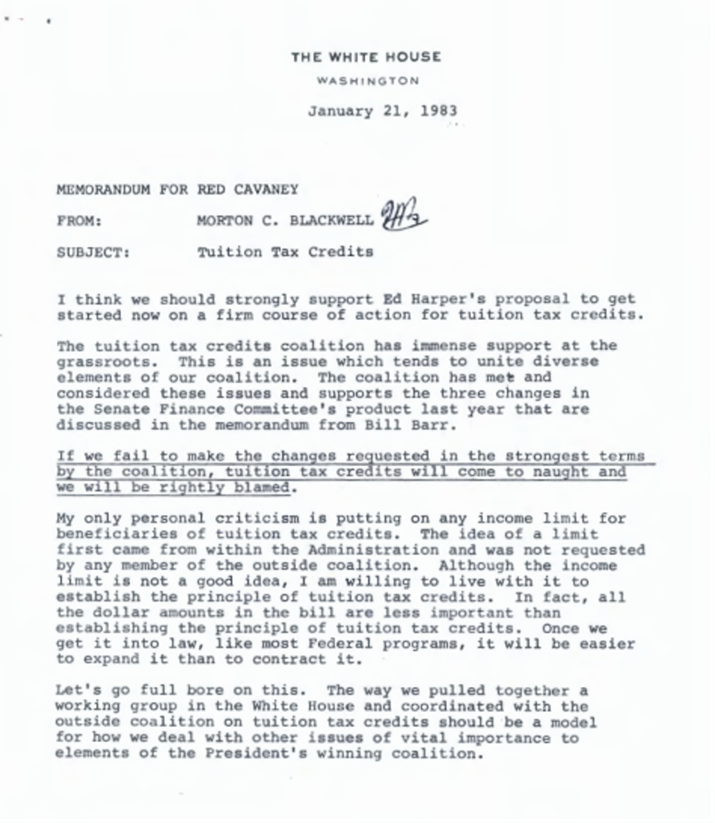
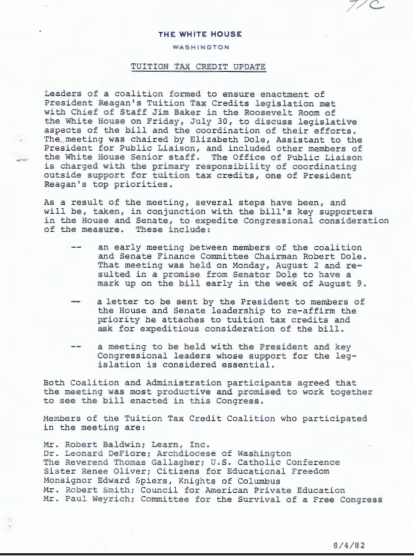
The second set of documents shows that the CNP network was not merely consulted by the administration. It was integrated into federal policymaking. A January 21, 1983 memo from Blackwell to Red Cavaney urged full support for Ed Harper’s tuition tax credit proposal and warned that failure to act would alienate the coalition. Blackwell emphasized that the tuition tax credit coalition had “broad grassroots support” and that the administration must “take firm action” to maintain credibility. He argued that establishing the principle of tuition tax credits mattered more than the specific dollar amounts and that the initiative could serve as a model for addressing other issues within the President’s coalition.
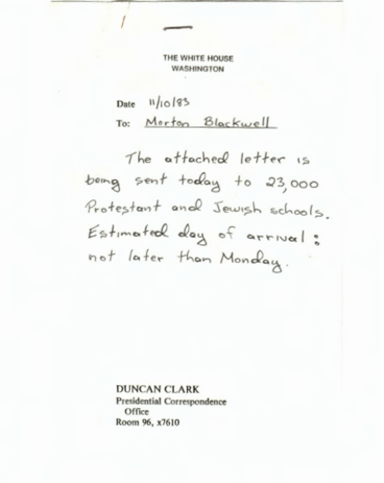
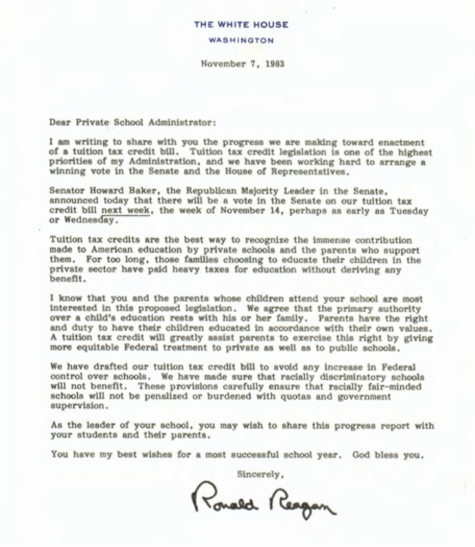
A November 1983 memo shows that the administration sent a coordinated political message to 23,000 Protestant and Jewish schools urging support for tuition tax credits ahead of a Senate vote. The memo was routed through Blackwell, confirming that the administration used religious schools as a mobilization base for a federal legislative initiative.
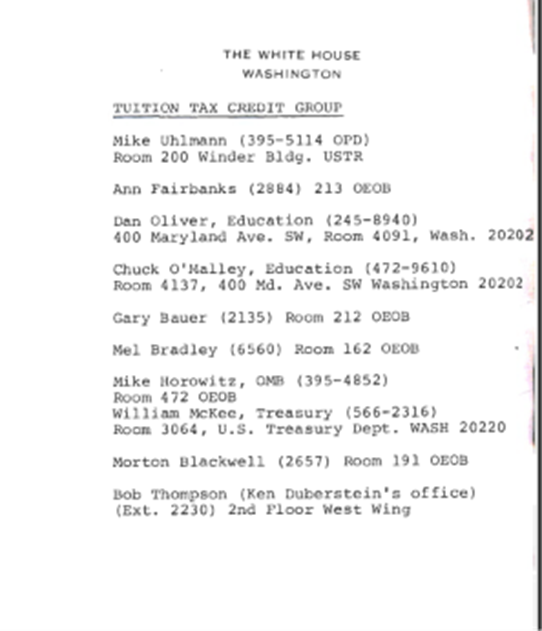
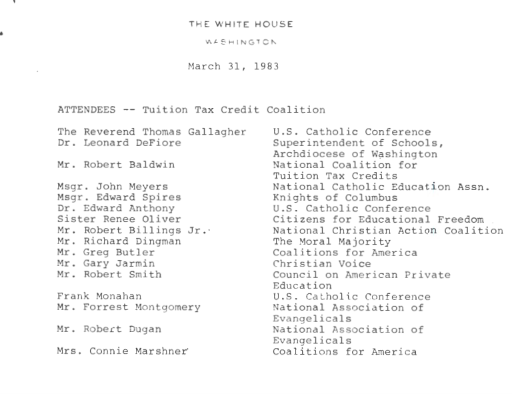
The documents also reveal the existence of a formal Tuition Tax Credit Group inside the White House. The roster included officials from the Office of Policy Development, the Office of Management and Budget, the Department of Education, the Treasury Department, Legislative Affairs, Public Liaison, and the Chief of Staff’s office, along with Blackwell. This group coordinated directly with outside organizations such as the Moral Majority, the United States Catholic Conference, the National Catholic Education Association, Eagle Forum, and United Families of America. Because many of these groups were led by CNP members, the White House was effectively coordinating with the CNP network through its constituent organizations.
External Mobilization
Insider testimony shows how the CNP network mobilized external organizations to pressure Congress and shape state policy. Earl Little, a central figure in the Christian school movement and an early CNP participant, wrote that “our nationwide Christian school movement had a major impact on Ronald Reagan being elected in 1980” and that Christian schools “depended on their combined ability to register and inform voters.” He also stated that “Dr. Tim LaHaye met with T Cullen urgently needing funds to begin the Council for National Policy” and that he “was invited to become part of CNP when it began” (2025). These statements reveal that the Christian school movement was not merely educational. It was a political mobilization apparatus integrated into the founding of CNP and the Reagan coalition.
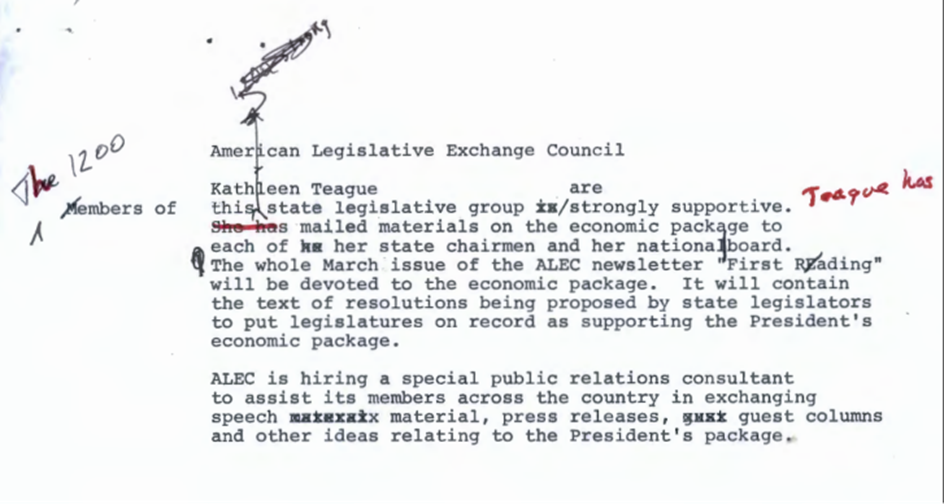
A memo concerning CNP member Kathleen Teague shows that the American Legislative Exchange Council coordinated messaging, distributed talking points, hired public relations consultants, and organized state legislative support for the President’s economic and education agenda. Although ALEC publicly claimed to be a nonpartisan educational nonprofit, the memo shows it functioning as a political mobilization arm for the Executive Branch. Teague’s dual role in ALEC and CNP demonstrates personnel integration between national and state‑level political networks.
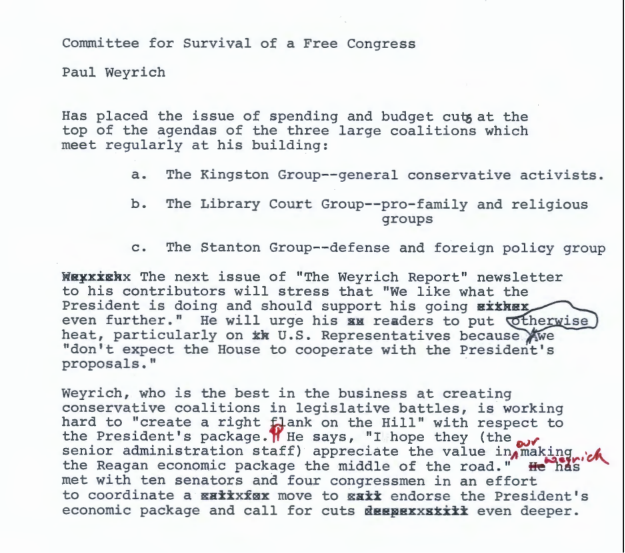
Paul Weyrich’s coalition memo further documents the creation of private, invitation‑only coalitions designed to pressure Congress on behalf of the administration’s agenda. These coalitions operated outside public oversight and drew on overlapping nonprofit structures, including Heritage, ALEC, and CNP. Because Weyrich was a founding member of CNP, these coalitions functioned as extensions of the same coordinating network.
Collectively, these documents show that the Reagan Administration and the CNP network worked in concert to redefine the constitutional baseline. They sought to normalize public funding of religious schools, embed the concept in federal policy, and construct a political coalition capable of sustaining that shift across decades. The goal was to create a political environment in which the exclusion of religious schools from public programs could be reframed as discrimination. That reframing is precisely the logic the Supreme Court adopted in Espinoza and Carson, where the Court treated state efforts to avoid funding religious instruction as “odious” discrimination rather than as traditional Establishment Clause safeguards.
The Reagan–Blackwell documents consequently illustrate that the doctrinal shift was not an accidental evolution of constitutional law. It was the intended outcome of a political project launched in the early 1980s, coordinated through private organizations operating outside public oversight, and executed through a multidecade pipeline of policy development, political training, litigation, and judicial influence. This political project did not remain abstract. It reshaped the educational landscape and produced the child‑rights vulnerabilities documented in the next section.
IV. The Modern CNP Infrastructure and the School‑Choice Network
The 2020 Council for National Policy directory reveals a national political infrastructure that now functions as the central coordinating hub for the modern school‑choice and ESA movement. What began in the early 1980s as a coalition of religious activists, donors, and policy entrepreneurs has matured into a vertically integrated system that spans litigation, legislation, media, donor financing, Christian education, and religious mobilization. The network is not diffuse. It is engineered. It is staffed. It is funded. And it operates with a level of internal coordination that mirrors the Reagan‑era strategy documented in the Blackwell files.
The modern CNP ecosystem contains six interlocking components, each supplying a distinct function within the school‑choice movement: (1) the litigation command structure, (2) the legislative and policy‑drafting engine, (3) the donor and financial pipeline, (4) the media and messaging apparatus, (5) the Christian education and curriculum bloc, and (6) the pastoral‑political mobilization system. Together, these components form a single political machine capable of reshaping state education systems across the country.
The Litigation Command Structure: Engineering the Free Exercise Revolution
The legal wing of the modern CNP network includes the most influential religious‑liberty litigators in the country. These organizations supply the legal theories, the test cases, and the judicial strategies that have dismantled the Establishment Clause and transformed the Free Exercise Clause into a tool for privatizing public education.
Key actors include:
Alliance Defending Freedom (Michael Farris; Alan Sears)
First Liberty Institute (Kelly Shackelford)
Liberty Counsel (Mat Staver)
Judicial Crisis Network (Carrie Severino)
Cooper & Kirk (Charles J. Cooper)
The Bopp Law Firm (James Bopp Jr.)
These organizations litigate to ensure that states cannot exclude religious schools from voucher or ESA programs, cannot impose secular standards on publicly funded religious instruction, and cannot enforce nondiscrimination rules that would apply to any public school. They also shape the judicial pipeline that produces judges sympathetic to these arguments. The result is a legal environment in which religious schools enjoy what scholars describe as a form of constitutional superstatus, insulated from oversight while guaranteed access to public funds.
The Legislative and Policy‑Drafting Engine: ALEC, SPN, and the State‑Level Pipeline
The legislative wing of the CNP network supplies the model bills, policy frameworks, and state‑level pressure campaigns that drive voucher and ESA expansion.
Key institutions include:
American Legislative Exchange Council (CEO Lisa B. Nelson)
State Policy Network affiliates (e.g., Buckeye Institute, Save Our States)
Conservative Partnership Institute (Jim DeMint)
Heritage Foundation (Edwin Meese III; Kay Coles James)
FreedomWorks (Adam Brandon)
These organizations draft the legislation that becomes universal voucher laws, ESA programs, and deregulation statutes. They coordinate with state legislators inside the network, including Jason Rapert (Arkansas), Mike Hill (Florida), and Barry Loudermilk (Georgia), ensuring that school‑choice bills move quickly through statehouses. They also supply the research, talking points, and political cover that lawmakers rely on when advancing privatization measures.
The Donor and Financial Pipeline: Funding Privatization at Scale
The donor class inside CNP provides the financial backbone of the school‑choice movement. These donors fund litigation, political campaigns, Christian schools, media outlets, and state‑level advocacy organizations.
Key donors include:
DonorsTrust and Donors Capital Fund (Lawson Bader)
Elsa Prince Broekhuizen
Foster Friess
The Bradley Foundation (Richard W. Graber)
The Maclellan Foundation (Robert H. Maclellan)
Hilda E. Bretzlaff Foundation (Gerald Radtke)
Richard Norman and American Target Advertising (Richard A. Viguerie)
These donors ensure that school‑choice campaigns are continuously funded, that litigation never lacks resources, and that political candidates who oppose vouchers face well‑financed primary challengers. DonorsTrust alone channels hundreds of millions of dollars into school‑choice organizations, religious‑liberty litigators, and state‑level policy shops.
The Media and Messaging Apparatus: Coordinated Narrative Control
The media wing of the CNP network shapes public opinion, amplifies anti‑public‑school narratives, and coordinates messaging across religious, political, and digital platforms.
Key media actors include:
Salem Media Group (Stuart Epperson)
Bott Radio Network (Richard Bott Sr. and II)
CNSNews / Media Research Center (Terence P. Jeffrey; L. Brent Bozell III)
PatriotPost.US (Mark Alexander)
OnMessage, Inc. (Timothy Teepell)
CRC Advisors (Michael W. Thompson Jr.)
These organizations produce and distribute messaging that frames public schools as unsafe, immoral, or ideologically hostile, while presenting vouchers and ESAs as solutions. They coordinate with political consultants, religious leaders, and litigation groups to ensure message discipline across the movement.
The Christian Education and Curriculum Bloc: The Institutional Beneficiaries
The CNP network includes the institutions that directly benefit from voucher and ESA expansion: Christian universities, Christian schools, and curriculum producers.
Key institutions include:
Hillsdale College (Larry Arnn; Douglas Jeffrey)
Colorado Christian University (Donald Sweeting; Jeffrey Hunt)
Columbia International University (Mark A. Smith)
Fairfax Christian School (Jo Thoburn)
Arizona Christian University (Len Munsil)
Summit Ministries (Jeff Myers)
These institutions train teachers, administrators, and political operatives; produce curricula used in voucher‑funded schools; and provide the ideological content that shapes the worldview of students in ESA programs. They are the institutional beneficiaries of the movement’s legal and political victories.
The Pastoral‑Political Mobilization System: Churches as Political Infrastructure
The CNP network includes a vast religious‑mobilization apparatus that converts congregations into political machines.
Key mobilizers include:
Faith and Freedom Coalition (Ralph Reed Jr.)
Faith Wins (Chad Connelly)
Salt & Light Council (Dran Reese)
Coalition of African American Pastors (William Owens)
STAND Foundation (E.W. Jackson)
Real Impact (Gina Gleason)
These organizations train pastors to mobilize voters, pressure legislators, and support school‑choice candidates. They frame public schools as spiritually dangerous and present vouchers and ESAs as moral imperatives. This religious‑mobilization system is the grassroots enforcement arm of the movement.
A Fully Integrated Political Machine
The modern CNP infrastructure is not a loose coalition. It is a vertically integrated political machine that coordinates:
litigation
legislation
donor financing
media messaging
Christian education
religious mobilization
political enforcement
youth recruitment
This machine is the successor to the Reagan‑era project documented in the Blackwell files. It has achieved what the 1980s coalition only envisioned: a national system in which public funds flow into private religious institutions, protected by constitutional doctrine, sustained by political pressure, and insulated from oversight.
The school‑choice movement is not a spontaneous grassroots phenomenon. It is the product of a forty‑year political strategy executed through a private network that now spans every sector of American conservative politics.
V. Public Funding of Religious Schools Creates a Constitutional Vulnerability That Harms Children and Undermines the Public Education Mission
The Supreme Court’s recent Free Exercise decisions have created a system in which states must fund religious schools but cannot require them to follow the protections that define public education. Children who attend these schools through voucher or ESA programs lose rights they would have in a public school, even though taxpayers are paying for their education. The Court has elevated institutional religious rights above the rights of minors and above the state’s responsibility to provide an adequate and equitable education. The result is a publicly financed system in which children are placed inside institutions that were historically built to resist oversight, suppress inquiry, and preserve racial and ideological separation.
Religious schools that receive public money are exempt from the civil rights laws that govern public schools. They are not required to follow federal nondiscrimination rules, disability protections, curricular standards, due process requirements, or safeguards against compelled religious activity. They may legally discriminate in admissions, discipline, curriculum, and student services. Investigations across multiple states show that voucher accepting religious schools use this freedom to impose policies that would be unconstitutional in any public school.
Compulsory religious practice is not incidental. It is institutional policy. The largest religious school networks in the country require daily worship, doctrinal instruction, and religious formation as part of the school day. The Association of Christian Schools International mandates daily Bible classes, weekly chapel, and the integration of faith into every academic subject. Lutheran Church–Missouri Synod schools require daily religion classes, weekly chapel, doctrinal instruction, and in many cases monitor church attendance. Catholic diocesan schools require Mass attendance, sacramental preparation, catechesis, and religious formation as part of the curriculum. These requirements apply to all students, including those attending through publicly funded voucher programs. Taxpayers are therefore subsidizing schools that require children to participate in religious activities with no meaningful way to opt out.
The discriminatory environment inside many of these schools is well documented. LGBTQ students may be denied admission, expelled for same sex relationships, or removed because their parents are gay or transgender. Some schools state openly that students may be dismissed for “lesbian, gay, bisexual and or transgender conduct.” Others allow expulsion for merely supporting LGBTQ peers. These policies are legal because religious schools are exempt from the civil rights protections that apply to public schools.
Pregnant students face similar treatment. Some schools require students to report pregnancies to administrators and attend Christian counseling. Others expel students immediately upon learning they are pregnant or suspend them until they provide medical proof. One school classifies pregnancy as a major disciplinary offense requiring intervention by administrators and, in some cases, law enforcement. These practices would be unlawful in public schools, yet they are funded with public dollars.
Students with disabilities are routinely screened out. Because religious schools are exempt from the Americans with Disabilities Act, they may refuse to admit students with disabilities or decline to provide services required under federal law. Families who rely on vouchers often discover that the school will not accommodate their child’s needs, leaving them without legal recourse.
Racial discrimination has deep roots in the private religious school sector. Voucher programs emerged in the South as a way for white families to avoid integration after Brown v. Board of Education. The curricula that dominate the Christian school market today, including ACE, Abeka, and BJU Press, were created in the middle of the segregation academy movement and the textbook wars of the 1970s. In Kanawha County, West Virginia, violent protests, dynamite attacks, and armed pickets erupted when new textbooks included Black authors and multicultural content. The uprising fused suburban evangelicals, rural fundamentalists, anti-government populists, and explicitly racist actors into a single political force. It was this coalition that built the modern Christian school movement and embraced the curricula that Indiana and dozens of other states now fund with public money.
Religious discrimination is equally pervasive. Many voucher funded schools maintain two-tiered admissions systems that favor members of their own congregations. Others impose religious litmus tests on families, requiring parents to sign statements of faith or attest to doctrinal positions unrelated to education. Some schools require families to affirm that homosexuality is sinful, that women must submit to male authority, or that salvation is available only within their denomination. One voucher accepting school in North Carolina denies admission to students from a list of “cults,” including Mormons, Jehovah’s Witnesses, Christian Scientists, Unitarians, and Buddhists. In Louisiana, when a Muslim school applied for voucher funds, a state legislator objected that he did not want public money to “fund Islamic teaching,” even though millions were already flowing to Christian schools. These examples reveal a structural asymmetry: public funds support religious discrimination inside schools while political actors simultaneously resist funding for minority faiths.
Many families who use vouchers to attend religious schools do not embrace the school’s religion. As Black reports, “Two thirds of families who used the vouchers to send their children to religious schools indicated that they did not embrace the religion of those schools but that the religious school was the only or best option available to them” (Black, 2022, p. 580). These families are not seeking religious formation. They are seeking safety, stability, or academic support, but the structure of the voucher system forces them into religious environments where their children lose constitutional protections.
Academic discrimination is widespread as well. Many voucher accepting religious schools refuse admission to students with low test scores or expel students who struggle academically. These are the very children voucher programs claim to serve. Public schools are required to educate all students. Voucher schools are not.
Low-income students face additional barriers. Because many religious schools do not participate in federal meal programs, students who rely on subsidized lunches may go without or face stigma when their financial aid status is visible to peers.
Academic quality in many publicly funded religious schools is deeply uneven, and in some cases demonstrably deficient. Research on fundamentalist Christian curricula shows significant academic deficits. A study of Accelerated Christian Education graduates found significantly lower ACT scores in English, Math, Reading, and Composite Score compared to graduates of a nearby public high school, with Science Reasoning as the only area without a significant difference (Kelley, 2005). These findings show that the academic preparation provided by many religious schools does not align with college readiness standards. Programs like ACE prioritize doctrinal obedience over critical thinking, scientific literacy, and evidence-based reasoning. Students spend much of the school day working through packets that replace inquiry with rote memorization and present religious claims as scientific fact. When states funnel public money into schools that use these materials, they are funding an education that leaves students at a measurable disadvantage compared to their public school peers.
The harms extend beyond curriculum. Indiana has repeatedly funded schools where abuse flourished in the absence of oversight. Colonial Christian School, which uses Abeka and BJU Press, received more than $1.5 million in voucher funds while a kindergarten teacher pleaded guilty to felony child seduction. Fishers Christian Academy, which uses Abeka, received more than half a million dollars in public funds while employing a teacher with prior allegations of misconduct involving minors. These cases are not anomalies. They reflect a structural problem: voucher funded schools operate inside closed religious systems where oversight is minimal, reporting is discouraged, and authoritarian pedagogy reinforces silence.
The Supreme Court’s decisions in Espinoza and Carson require states to fund these schools but prohibit them from imposing the protections that safeguard children’s rights. States may not exclude religious instruction from publicly funded programs. They may not restrict how public money is used once it enters a religious school. They may not require religious schools to provide an education equivalent to that required of public schools.
The result is a constitutional environment in which institutional religious rights override the rights of minors and the state’s responsibility to secure equitable and adequate education for all children. Public money now flows into institutions that can legally discriminate, legally exclude, and legally impose religious requirements on children who have no constitutional protections once they walk through the door.
This system is the predictable outcome of a political and legal project that began in the early 1980s and succeeded in reshaping the constitutional landscape. The Court’s doctrine now protects the autonomy of religious institutions while stripping children of the rights they would otherwise possess in public schools. States are compelled to fund schools that can discriminate, exclude, indoctrinate, and conceal abuse without oversight.
References
Black, D. W. (2022). When religion and the public-education mission collide. Yale Law Journal Forum, 132, 558–602.
Council for National Policy. (2020, November 1). CNP September 2020 membership directory. Documented. https://documented.org/media/cnp-membership-directory-september-2020
Kelley, L. J. L. (2005). An analysis of Accelerated Christian Education and college preparedness based on ACT scores (Master’s thesis, Marshall University). Marshall Digital Scholar. https://mds.marshall.edu/cgi/viewcontent.cgi?article=1093&context=etd
Little, E. (2025, February 9). President Ronald Reagan, Carolyn & Earl Little 1980. Earl Little Blog. https://web.archive.org/web/20250305083734/https://earllittle.com/f/president-ronald-reagan-carolyn-earl-little-1980#expand
Republican Party. (1980, July 15). Republican Party platform of 1980. The American Presidency Project. https://www.presidency.ucsb.edu/documents/republican-party-platform-1980
Ronald Reagan Presidential Library. (1981–1983). Internal memoranda and correspondence from the Office of Public Liaison [Unpublished archival documents]. National Archives and Records Administration.
I like how you name names. 😮 I have so much respect for people like you who speak truth to power.
Thanks for covering this important issue. If families have a problem with public schools, they can either be part of the solution or fund their own schools. Expecting taxpayers to fund their narrowminded curricula is pathetic. I have equally strong opinions about charter schools who only accept the "best" students.
I had thought ALEC was disbanded a while back. Is it still in operation?
Just a minor detail: I don't think standardized tests deserve that much validation. I suspect they're more about $$ than fair, evidence-based assessment. I do appreciate the attempt at an objective way to measure academic progress, though.
The way the CNP has too many Billionaire funded orgs at their disposal will always trouble me, like what happened to the “rich man shall hardly enter into the kingdom of heaven” 💔🥀